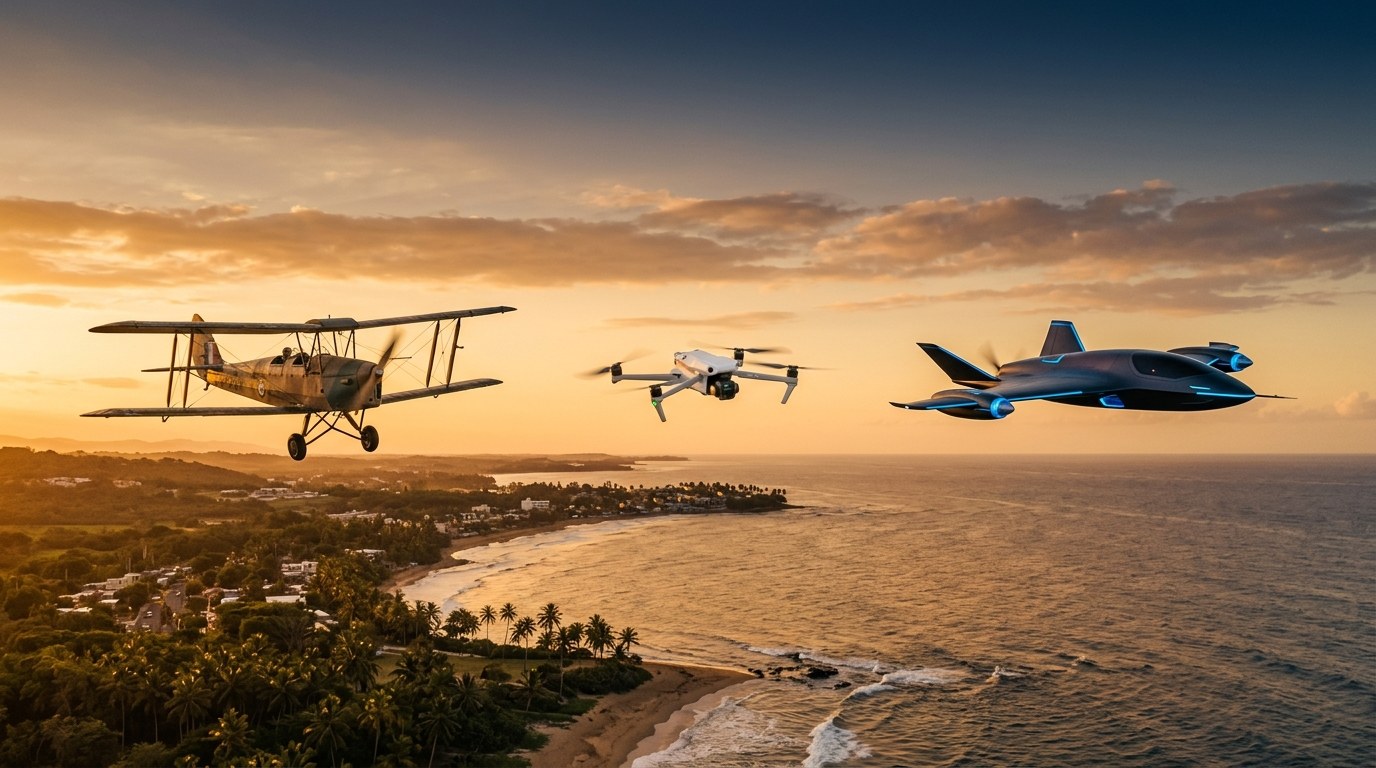
From a wooden biplane in 1917 to the smart drone in your backpack — a century of unmanned flight, where it's headed, and what it means for pilots in Puerto Rico.
Why History Makes You a Better Pilot
Every switch on your controller exists because someone, somewhere, learned a lesson the hard way. When you understand where drones came from, the rules, the technology and even the word itself stop being random — they become a story you're now part of.
The Beginning: War, Radio and a Queen Bee (1917–1990)
1917 — The Kettering Bug, a wooden "aerial torpedo" built during WWI, becomes the first attempt at a self-flying aircraft. It flew without a pilot, guided by a simple gyroscope and a mechanical counter that cut the engine after a set distance.
1935 — Britain's de Havilland DH.82 Queen Bee, a radio-controlled target biplane, gives unmanned aircraft their name: "drone," after the male bee that follows the queen.
1940s — The Radioplane company mass-produces target drones for WWII gunners. A young factory worker named Norma Jeane Dougherty is photographed at one of their assembly lines — she later becomes Marilyn Monroe.
1960s — The Ryan Firebee flies reconnaissance missions over Vietnam, proving drones can do more than be shot at.
1980s — Israel perfects real-time battlefield drones, showing the world their value as eyes in the sky.
1995 — GPS plus the General Atomics Predator changes warfare forever: persistent surveillance and precision from a continent away.
The Present: The Smartphone Revolution (2010–Today)
2013 — DJI's Phantom puts a stabilized flying camera in civilian hands. The secret? Smartphone components — gyroscopes, GPS chips, cameras and lithium batteries — had become tiny and cheap.
2016 — The FAA creates Part 107, giving commercial drone work a legal path in the United States, including Puerto Rico.
2018 — TRUST brings safety education to every recreational pilot. Yes, the same TRUST you can study for in our Study Hall.
2024 — Remote ID enforcement begins: drones now broadcast who and where they are, like a digital license plate.
Puerto Rico — After Hurricane María, drones mapped destroyed roads, inspected power lines and found people cut off by landslides. Today they check roofs after storms, survey crops, shoot real estate and help search and rescue across the island.
The Future: BVLOS, Delivery and Air Taxis
BVLOS — Beyond Visual Line of Sight waivers are expanding: drones will routinely fly miles from their pilots for inspection and delivery.
Delivery — Medical supplies first, packages next. Rural and island communities like ours stand to gain the most.
Air taxis — eVTOL aircraft, essentially giant passenger drones, are already flying in certification programs.
AI autonomy — Tomorrow's drones will plan their own routes, dodge obstacles and land themselves in emergencies.
Swarms — Coordinated fleets for light shows, agriculture and disaster mapping.
The pattern never changes: every generation removes a barrier. First the pilot left the cockpit. Then the price left the stratosphere. Next, the flight plan writes itself.
Your Place In The Story
That DJI Air 3S in my backpack carries a hundred years of lessons — from the Kettering Bug's gyroscope to the Queen Bee's radio link to the Phantom's smartphone brain. When I fly over a marina in Ponce, I'm the newest chapter of a very old story.
So are you. Watch how a total rookie joins the story: The Rookie Series on YouTube →
And when you capture your own piece of history, share it in the Gallery →
Fly it like you planned it.